Chat with us, powered by LiveChat Emergence of Flexo Printing: Transforming Print Technologies
Skip to content
Discount for You - Be Happy - Use Code HAPPY5
Free Shipping Over $100
Discount for You - Be Happy - Use Code HAPPY5
Free Shipping Over $100
Discount for You - Be Happy - Use Code HAPPY5
Free Shipping Over $100
Discount for You - Be Happy - Use Code HAPPY5
Free Shipping Over $100
Discount for You - Be Happy - Use Code HAPPY5
Free Shipping Over $100
logo
1300 986 000
sales@garmentprinting.com.au

  • Home
  • Products
    • T-Shirts
    • Workwear
    • Hi Vis Safety Wear
    • Dri Fit Shirts
    • Singlets
    • Polos
    • Hoodies
    • Sweatshirts
    • Jackets
    • Head Wear
    • Activewear
    • Corporates Clothing
    • Hospitality wear
    • Health Wear
    • Pants & Shorts
    • Totes & Bags
    • Bring Your Own Garment
  • Services
    • Direct to Garment Printing
    • DTF Printing
    • Screen Printing
    • Sublimation
    • Vinyl Heat Transfers
    • Laser Transfers
    • Digital Full Colour Transfers
    • Embroidery
    • Puff Printing
  • Business Solutions
    • Workwear
      • Construction and Building Safety
      • House Movers
      • Gardeners
      • Pool Cleaners
      • Solar Panel Installers
      • Cleaners
      • Mechanic and Automotive
      • Plumbers
      • Roofers
      • Carpenter
      • Farmers
      • Electrician
      • Food Industry
      • Miners
      • Traffic Controllers
      • Transportation & Logistics
      • Freezerwear
      • Fire Warden
      • Rainwear
      • Railway
      • Security
    • Sports Teams & Clubs
      • Rugby
      • Bowling
      • Golf
    • Healthcare
    • Social Media Influencers
    • MUSIC & BANDS
    • Charitable Organisations & NFP
    • University Clubs & Associations
    • Local Councils & Government Agencies
    • Real Estate Agencies & Motor Dealerships
    • Bars & Restaurants
    • Events & Festivals
    • Hair & Beauty
    • Franchise Printing
    • Corporate Printing
    • Trade Printing
    • Gymnastics
  • Bulk Order Quote
  • About Us
    • Printed in Australia
    • Retail Quality Brands
    • Free Design Review
  • Contact Us
    • Contact Us
    • Customer Care
  • Help
    • User Agreement
    • Privacy Policy
    • Shipping Information
    • Refund & Return Policy
    • Bulk Order Discounts
    • Price Beat Guarantee
    • Sampling Policy

  • Home
  • Products
    • T-Shirts
    • Workwear
    • Hi Vis Safety Wear
    • Dri Fit Shirts
    • Singlets
    • Polos
    • Hoodies
    • Sweatshirts
    • Jackets
    • Head Wear
    • Activewear
    • Corporates Clothing
    • Hospitality wear
    • Health Wear
    • Pants & Shorts
    • Totes & Bags
    • Bring Your Own Garment
  • Services
    • Direct to Garment Printing
    • DTF Printing
    • Screen Printing
    • Sublimation
    • Vinyl Heat Transfers
    • Laser Transfers
    • Digital Full Colour Transfers
    • Embroidery
    • Puff Printing
  • Business Solutions
    • Workwear
      • Construction and Building Safety
      • House Movers
      • Gardeners
      • Pool Cleaners
      • Solar Panel Installers
      • Cleaners
      • Mechanic and Automotive
      • Plumbers
      • Roofers
      • Carpenter
      • Farmers
      • Electrician
      • Food Industry
      • Miners
      • Traffic Controllers
      • Transportation & Logistics
      • Freezerwear
      • Fire Warden
      • Rainwear
      • Railway
      • Security
    • Sports Teams & Clubs
      • Rugby
      • Bowling
      • Golf
    • Healthcare
    • Social Media Influencers
    • MUSIC & BANDS
    • Charitable Organisations & NFP
    • University Clubs & Associations
    • Local Councils & Government Agencies
    • Real Estate Agencies & Motor Dealerships
    • Bars & Restaurants
    • Events & Festivals
    • Hair & Beauty
    • Franchise Printing
    • Corporate Printing
    • Trade Printing
    • Gymnastics
  • Bulk Order Quote
  • About Us
    • Printed in Australia
    • Retail Quality Brands
    • Free Design Review
  • Contact Us
    • Contact Us
    • Customer Care
  • Help
    • User Agreement
    • Privacy Policy
    • Shipping Information
    • Refund & Return Policy
    • Bulk Order Discounts
    • Price Beat Guarantee
    • Sampling Policy

Emergence of Flexo Printing: Transforming Print Technologies
Printing

Emergence of Flexo Printing: Transforming Print Technologies

October 9, 2023August 28, 2025 Lisa John
Table Of Contents hide
1 Flexo Printing
2 What Sets the Flexographic Printing Method Apart?
3 Flexographic Printing and Letterpress Printing
4 Flexo printing Vs. Offset Printing
4.1 Plates
4.2 Ink
4.3 Components
5 The Flexo-Printing Technique
5.1 Making of plates
6 Conclusion

Flexographic printing has been widespread for decades. Examples include candy wrappers, refreshment bags, cereal boxes, plastic shampoo bottles, peel-able double-sided medication labels, notebooks, legal pads, desk calendars, and your seasonal roll of printed paper towels.

Almost everything that is printed today can be flexographically produced.

It may seem like magic, but the steps of flexo printing are best explained as a meticulously choreographed science that results in a beautiful and functional printed product.

Flexo Printing

Flexographic or flexo printing is a technique that transfers pigment onto a variety of substrates using heat and pressure. Due to its ability to print on a wide variety of substrates and its high level of detail, its prevalence has increased.

Unlike traditional lithographic printing, flexographic printing employs oil-based inks rather than water. This makes the process quicker and more efficient than lithography, which frequently requires days of curing time between steps.

In this article, you’ll learn about flexographic printing, its effective technique, and how to leverage its benefits for your business.

What Sets the Flexographic Printing Method Apart?

Flexographic printing employs a blanket, drum, or press to apply pigment to a flat surface. It is used in the printing industry due to its low cost and high-quality output. Flexography is used in various applications, including posters, labels, T-shirts, and packaging.

Flexography entails covering a surface with a malleable material (such as paper or plastic) and pressing it against a rigid surface (such as cardboard) in its most fundamental form. A roller or roller head is then applied to pressure the malleable surface, forcing the ink through the blanket onto the other surface.

Typically, flexography requires the following steps:

  • Ink application to a substrate
  • Utilizing force to press pigment through the substrate
  • The process of removing the substrate from the covering.
  • Ink transfer from the blanket to another surface
  • Repeat stages 1 through 4 until the desired result is attained.

Flexographic printing is the process of printing on a flexible surface, such as paper, with a combination of thin and dense lines. It is occasionally referred to as flexography, flexo lithography, or flex scope.

Flexography can also print on plastic, metal, and paper. For instance, flexible substrates can create large-scale posters and signs.

Flexographic Printing and Letterpress Printing

The only difference between flexographic printing and letterpress printing is using pigment instead of type. Both procedures qualify as typesetting. Because it shares many similarities with letterpress printing, flexography is often mistaken for a form of letterpress printing.
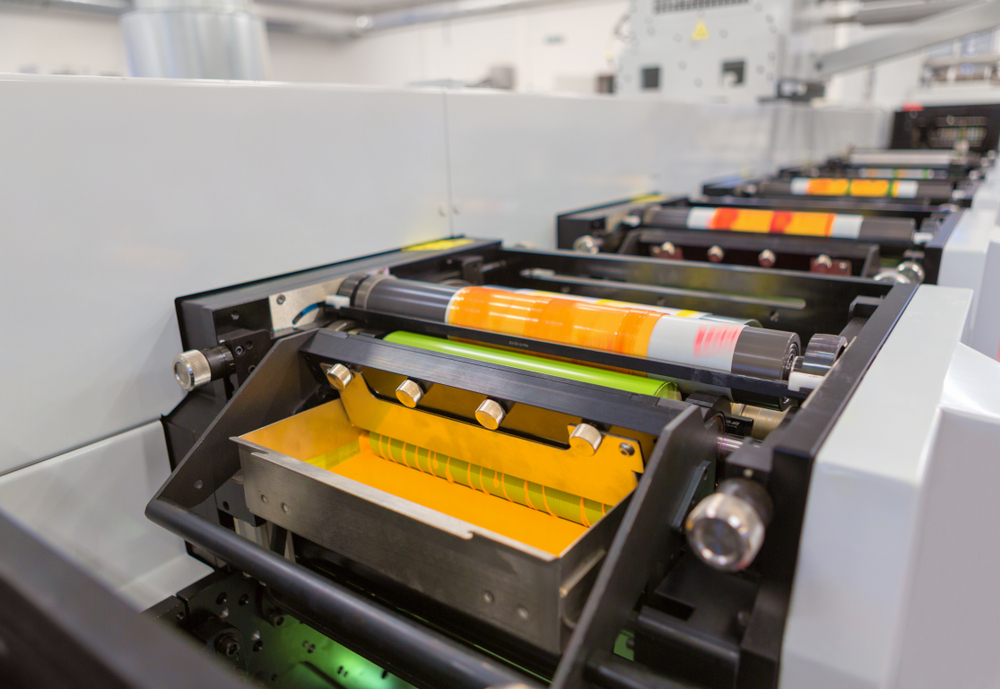
Flexographic Printer Ink Try

Nevertheless, flexography is a distinct technique that generates results that are only sometimes comparable to letterpress printing. While letterpress printing presses ink onto paper using weighty plates (or stereotype plates), flexography presses ink onto paper or plastic using light sheets (or placemats).

In both procedures, the image is transferred from the plate to the paper via impressions, which involve rubbing the plate back and forth over the paper.

Letterpress printing does this manually, while flexography does it mechanically (through rolling). In flexography, the ink is transmitted to the substrate using a roller that presses against the substrate and transfers ink with each pass.

Flexo printing Vs. Offset Printing

Offset and flexo printing use wet pigment and plates, but their techniques differ. Flexo prints directly from the plate to the substrate, whereas offset transfers the image from the plate to an intermediate carrier and then to the substrate. The choice between them is determined by the nature of the product, its quality, quantity, and substrate.

Plates

Flexo utilises flexible plates wrapped around a photopolymer cylinder. Each colour necessitates its plate. The image is printed directly onto the substrate, and adequately stored plates can be reused.

Flexographic Printing Plates

Offset printing utilises aluminium plates. Ink transfers via rollers onto the plate, then to a ‘blanket’, and lastly to the substrate.

Ink

Offset printing typically employs four ‘process’ colours (cyan, magenta, yellow, and black) with corresponding stations. There are both water-based and UV-curable inks.
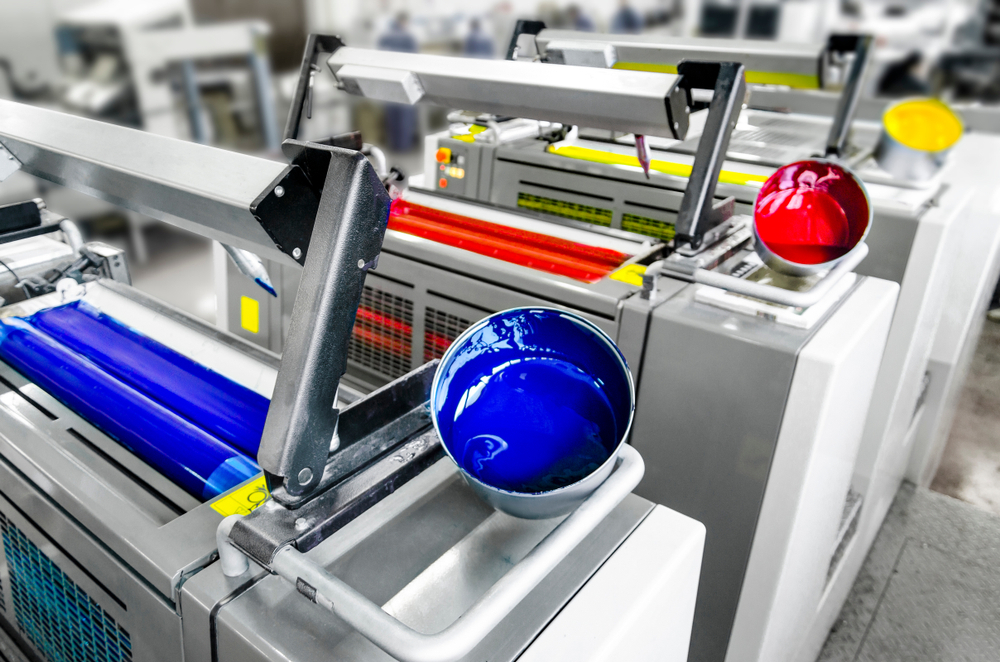
Offset Printer Inks Display RGB

Flexo printing can utilise process colours but typically has additional stations for spot colours. Inks can be solvent-based, water-based, or UV-curable. UV inks permit faster rates and can be left in the press, whereas water-based inks must be removed to avoid drying.

Components

Offset printing is utilised on smooth, flat materials such as paper, metal, and vinyl. It is ideally suited for newspapers, novels, and pamphlets. Additional processes, such as two-sided printing and die-cutting, are performed separately.

Flexo printing is primarily used for packaging various materials, including cellophane, foil, and fabric. Unlike offset, flexo printing can be applied to any flexible surface and frequently combines multiple processes to expedite production.

The Flexo-Printing Technique

Thousands of different varieties of flexographic printers are available, with the best being publicly available in the United Kingdom, Europe, and the United States. In Australia, with its rapidly growing printing industry, understanding the mechanism of flexo printing machines can equip you with the knowledge to comprehend others, given they all employ the same printing method. 

Each machine employs the same printing method, so you can comprehend the others if you are familiar with one flexo machine.

The essential components of the process are described below:

Making of plates

The printing plate, which contains the images and text to be printed in negative as a mirror image, is the most vital component of flexography. A distinct plate must be created for each color in the print run. Placemaking is a distinct art and science.

There have been three primary approaches historically:

Rubber Plates

The print image is first incised in negative onto a zinc or magnesium metal plate, then washed in an acid bath. On the plate, the image will appear in bas relief. The second step involves the creation of a plastic mold, which is then used to create the final printing plates from a thermoplastic, flexible polymer.

This is a costly and time-consuming method that is rarely employed today.

Photopolymer Plates

The print image is etched directly onto a light-sensitive polymer plate using ultraviolet light and a photo negative. When the polymer has hardened, it is rinsed out in a bath of water or solvent at approximately 40°C. This is still the most prevalent system of flexo plate production today.

Digital Plates

This cutting-edge technique employs a computer-controlled laser and a digital image to etch the printing plate. This eliminates the need for a photo negative and is currently the fastest-growing platemaking technique.

Conclusion

Flexographic printing is one of the most prevalent printing processes in use today. It is used for packaging, product labelling, and even currency printing.

Considering this, many people are curious about how to use this printing method to produce the highest quality prints feasible.

Flexographic printing is a terrific and cost-effective printing method that can be utilised for various purposes. This article has been an informative introduction to flexographic printing.

Similar Posts

Embroidered Logos vs Printed Logos: What Are the Differences for Business Apparel?

Embroidered Logos vs Printed Logos: What Are the Differences for Business Apparel?

June 28, 2026June 30, 2026 Lisa John
Innovative Sports Team Merch Ideas to Stand Out in 2026

Innovative Sports Team Merch Ideas to Stand Out in 2026

August 11, 2023January 5, 2026 Lisa John

Post navigation

Previous Choosing What to Wear in a Warehouse: Essential Tips
Next The Perfect Balance: Work-Appropriate Halloween Costumes 2025

Recent Posts

  • Softshell vs Hardshell Jackets: What’s the Difference?
  • What’s the Best Fabric for Custom Work Jackets?
  • Embroidery Placement Guide: Best Spots for Polos, Hoodies, Jackets, and Caps
  • Embroidered Logos vs Printed Logos: What Are the Differences for Business Apparel?

Categories

  • 3D Printing
  • Brands
  • Business
  • Corporate
  • Custom Apparel
  • Custom Hoodies
  • Custom T Shirts
  • Design
  • DIY
  • DTF Printing
  • DTG Printing
  • Embroidery
  • Fabrics
  • Fashion
  • Hair & Beauty
  • Headwear
  • Healthcare
  • Hospitality
  • Jackets
  • Polo Shirts
  • Printing
  • Screen Printing
  • Singlets
  • Sports Uniforms
  • Sublimation
  • Totes & Bags
  • Workwear
Close

Sign up to our newsletter

and be first to know about special offers.

Find us
Custom Brands Pty Ltd
2/7 Anella Avenue
Castle Hill NSW 2154
Australia
Contact us
  • 1300 986 000
  • sales@garmentprinting.com.au
  • support@garmentprinting.com.au
ABN

ABN: 74640879474
ACN: 640879474

Payments
Our services
  • Direct to Garment Printing
  • Vinyl Heat Transfers
  • Screen Printing
  • Sublimation
  • Laser Transfers
  • Digital Full Colour Transfer
  • Direct to Film Printing
  • Embroidery
  • Puff Printing
Information
  • About Us
  • What We Do
  • Blog
  • Privacy Policy
  • User Agreement
  • Purchase / Refund Policies
  • Brands
  • Testimonial & Reviews
  • Glossary
Payments
  • paypal PayPal
  • MasterCard MasterCard
  • Visa Visa
  • American Express American Express
  • Bank Transfer Bank Transfer
  • Apple Pay
  • Google Pay
Our services
  • Direct to Garment Printing
  • Vinyl Heat Transfers
  • Screen Printing
  • Sublimation
  • Laser Transfers
  • Digital Full Colour Transfer
  • Direct to Film Printing
  • Embroidery
  • Puff Printing
Information
  • About Us
  • What We Do
  • Blog
  • Privacy Policy
  • User Agreement
  • Purchase / Refund Policies
  • Brands
  • Testimonial & Reviews
  • Glossary
About us
  • Privacy Policy
  • User Agreement
  • Purchase / Refund Policies
Our Products
  • T Shirts Printing
  • Singlets Printing
  • Polos Printing
  • Hoodies Printing
  • Jackets Printing
  • Dri Fit Shirts Printing
  • Workwear Printing
  • Hi Vis Safety Wear Printing
  • Sports Wear Printing
  • Corporates Printing
  • Hospitality Printing
  • Health Wear Printing
  • Active Wear Printing
  • Pants & Shorts Printing
  • Headwear Printing
  • Totes & Bags Printing
Trustpilot
4.4/5
★
★
★
★
★
Enterprise Solutions
  • Cleaning
  • Security
  • Construction
We deliver to
  • Sydney
  • Newcastle
  • Perth
  • Melbourne
  • Brisbane
  • Adelaide
  • Canberra
  • Hobart
  • Darwin
  • Central Coast
  • Geelong
  • Sunshine Coast
  • Gold Coast
  • Cairns
  • Townsville
  • Wollongong
  • Launceston
Trustpilot
4.4/5
★
★
★
★
★
4.4/5
★
★
★
★
★
4.4/5
★
★
★
★
★
Enterprise Solutions
  • Cleaning
  • Security
  • Construction
We deliver to
  • Sydney
  • Newcastle
  • Perth
  • Melbourne
  • Brisbane
  • Adelaide
  • Canberra
  • Hobart
  • Darwin
  • Central Coast
  • Geelong
  • Sunshine Coast
  • Gold Coast
  • Cairns
  • Townsville
  • Wollongong
  • Launceston
Subscribe to our newsletter

Copyrights © Garment Printing. All rights have been reserved.

Play sound

Sign up to our newsletter

and be first to know about special offers.